
CerFlux Presents Tumor Microenvironment Model Benchmarking Studies at AACR
SAN DIEGO, CA, (April 19, 2026) — At the 2026 American Association for Cancer Research (AACR) Annual Meeting — the focal point of the global cancer research community — CerFlux and its collaborators at the UAB Department of Surgery and the UAB Division of Gynecologic Oncology presented work addressing one of the most consequential questions in preclinical oncology: when we study cancer in a model, how do we know the model behaves like the patient? Across two posters published in Cancer Research, the team benchmarked how faithfully widely used preclinical models reproduce the human tumor microenvironment — and showed where they drift.
The stakes behind that question are easy to underestimate. As human-relevant New Approach Methods (NAMs) move from promise to practice, the field’s credibility rests less on whether a model is novel than on whether it is faithful — whether the tissue under study responds the way a patient’s tumor would. Benchmarking is how that faithfulness gets earned rather than asserted.
To make the idea tangible, CerFlux often uses a simple analogy, comparing tumors to chocolate-chip cookies and muffins. They share nearly the same ingredients but turn out quite differently because of how those ingredients are arranged. In cancer models, the “chocolate chips” – the cancer cells – are only part of the story; features of the surrounding “batter” – the tumor microenvironment (TME) – often decide whether a treatment works or not. A model that captures the chips but not the batter can therefore be misleading.

On April 19, Dr. Rachael Guenter presented “Bridging the Translational Gap: Critical TME Differences Between Human PDAC and Mouse Models” (Cancer Research; DOI: 10.1158/1538-7445.AM2026-763) — a head-to-head comparison of the tumor microenvironment in human pancreatic ductal adenocarcinoma (PDAC) and a mouse model that is commonly used to study it. The work mapped where microenvironmental composition and spatial organization diverge between human disease and model — differences that can alter drug delivery, treatment response, and the interpretation of preclinical results. In desmoplastic tumors like PDAC, the poster argued, model choice is not a logistical detail but something closer to a therapeutic variable: choose the wrong stand-in for the human microenvironment, and the experiment can answer the wrong question.
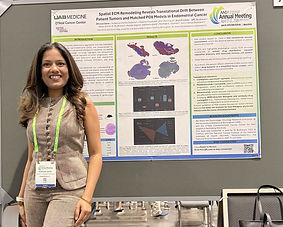
The following day, Dr. Dhruva Dave presented “Spatial ECM Remodeling Reveals Translational Drift Between Patient Tumors and Matched PDX Models in Endometrial Cancer” (Cancer Research; DOI: 10.1158/1538-7445.AM2026-2616), turning the same benchmarking lens on patient-derived xenografts. Comparing patient endometrial tumors with their matched PDX models, the study found that spatial remodeling of the extracellular matrix (ECM) — the structural scaffold of the microenvironment — can quietly shift between patient and model, producing what the authors call translational drift. The takeaway is pointed: evaluating cancer cells in isolation is not always enough, because the spatial ECM context around them can change the experimental answer. Treating ECM remodeling as a first-class variable, rather than background, makes preclinical efficacy studies easier to trust.
Together, the two reports point to the same fundamental lesson: model fidelity depends not only on the cancer cells, but also on the surrounding “neighborhood” in which they live and respond to treatment. This is because the ECM, spatial organization, and microenvironmental context can quietly shift the model readout away from clinical reality.
That emphasis is not academic. It underwrites the central aim at CerFlux: understanding why the same treatment behaves differently across patients, and using that understanding to match therapies to tumors so that more patients receive treatments that work for them.
From the AACR poster floor to the lab bench in Birmingham, CerFlux and its collaborators are building toward a standard where model fidelity is measured, evidence is human-relevant, and treatments are matched to tumors with greater confidence.